
Under canopy lighting is becoming an increasingly important part of commercial cannabis cultivation lighting strategies, but simply adding more light beneath the canopy does not always deliver the best results. How and when that light is delivered can be just as important as fixture intensity.
To maximize the value of under canopy lighting, growers can move beyond an “always-on” approach and use dynamic dimming schedules that coordinate under canopy grow lights with top lighting, plant development, Daily Light Integral (DLI), and environmental conditions.
Because under-canopy lighting targets the shaded and often more sensitive lower portion of the plant, its scheduling should work in coordination with top lighting and the plant’s daily light cycle.
TSRgrow recommends a more integrated approach that adjusts light intensity throughout the photoperiod to deliver light where and when the crop can use it most effectively.
Under Canopy Lighting Strategy: Follow the Sun
In nature, lower leaves receive relatively little direct light at dawn and dusk, with light availability increasing as the sun rises and penetrates deeper into the canopy.
Moving shaded lower leaves directly from darkness to high-intensity light may create unnecessary light stress. Instead, a more gradual under canopy lighting strategy can complement top lighting by increasing and decreasing intensity throughout the day.
The goal is not simply to add more photons beneath the canopy. It is to coordinate top and under canopy lighting so the entire plant receives more useful light throughout the photoperiod.
Recommended Under Canopy Lighting Dimming Schedules
Flowering Phase: 12-Hour Photoperiod
During flower, under canopy grow lights can help deliver usable light to lower and mid-level flower sites that would otherwise remain heavily shaded.
However, the lower canopy does not necessarily require the same intensity or light schedule as the upper canopy.
A staged dimming strategy can help growers gradually increase under canopy lighting as the crop moves into its peak photosynthetic period.
- Hours 0 to 1 – Wake Up: Top lights turn on or begin ramping. Keep under canopy lighting at 0% to 20% while the plant transitions out of the dark period.
- Hours 1 to 3 – Mid-Morning Ramp: Increase under canopy lighting to approximately 50% as top lighting approaches full intensity.
- Hours 3 to 9 – Peak Day: Run under canopy lighting at approximately 80% to 100%, depending on cultivar response, canopy density, environmental conditions, and overall light targets.
- Hours 9 to 11 – Wind-Down: Reduce under canopy lighting back to approximately 50% as the crop moves toward the end of the photoperiod.
- Hours 11 to 12 – Sunset: Reduce under canopy lighting to approximately 20% or off as top lights dim or finish their cycle.
| Flowering Photoperiod | Top Light Status | Recommended Under Canopy Lighting |
|---|---|---|
| Hours 0–1 | On / Ramping | 0–20% |
| Hours 1–3 | Approaching Full Intensity | 50% |
| Hours 3–9 | Full Intensity | 80–100% |
| Hours 9–11 | Full Intensity / Beginning Wind-Down | 50% |
| Hours 11–12 | Dimming / Off | 20–0% |
*These percentages should be treated as a strategic starting point rather than a universal recipe. Cultivar, canopy structure, environmental conditions, CO₂ levels, top-light intensity, and target DLI should all influence the final lighting strategy.
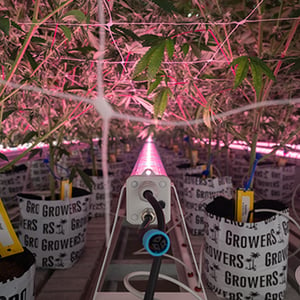 Vegetative Phase: 18-Hour Photoperiod
During vegetative growth, the goal of under canopy lighting is different.
The canopy is generally less dense, so top lighting may already reach more of the lower plant structure. Under canopy grow lights can be used more selectively to support lower shoots, branch development, and overall plant structure before the transition to flower.
A possible vegetative dimming schedule includes:
- Hours 0 to 2: Under canopy lighting at 0% to 20%
- Hours 2 to 6: Increase to approximately 40%
- Hours 6 to 14: Increase to approximately 60% to 70%
- Hours 14 to 17: Reduce to approximately 40%
- Hours 17 to 18: Reduce to 20% or off
Running under canopy lighting at maximum output throughout vegetative growth may not be necessary. Growers should evaluate plant response and adjust intensity based on crop structure, spacing, and overall DLI goals.
How Under Canopy Lighting Works with Top Lighting
Under canopy lighting should not be treated as a completely separate lighting system.
Top lighting and under canopy lighting contribute to the same crop and the same overall light environment. The most effective strategy considers how the two systems work together.
Manage Total Daily Light Integral
Adding under canopy grow lights increases the total amount of light the plant receives.
If growers add under canopy lighting while leaving top lights at maximum intensity, the crop may receive more light than it can effectively use.
For facilities already achieving their target DLI, adding under canopy lighting may create an opportunity to redistribute light rather than simply increasing total light output.
For example, growers may choose to reduce top-light intensity during peak under canopy lighting periods while maintaining the desired overall light target.
This can help deliver more light to previously shaded plant material without unnecessarily increasing total light consumption.
Consider the Under-Canopy Microclimate
Lighting changes more than PPFD.
Under canopy lighting can also influence temperature, transpiration, humidity, and airflow within the lower portion of the crop.
Dense canopies are especially prone to microclimates because air movement and environmental conditions can vary significantly between the top and bottom of the plant.
Running under canopy lighting at full intensity for an entire photoperiod may contribute to increased transpiration and localized heat or humidity beneath the canopy.
A gradual dimming schedule allows lighting changes to occur more progressively while cultivation teams monitor how the environment responds.
Environmental sensors can provide additional visibility into temperature, relative humidity, VPD, and CO₂ conditions across different areas of the room.
Use Under Canopy Lighting as Part of Crop Steering
Under canopy lighting can also become part of a broader crop steering strategy.
During early and mid flower, higher under canopy lighting intensity may support reproductive growth and flower development across more of the plant.
As the crop approaches harvest, growers may choose to reduce under canopy lighting intensity based on plant response, environmental conditions, and changing light requirements.
Rather than following the same lighting schedule from the first day of flower through harvest, cultivation teams can adjust under canopy lighting as the crop develops.
This creates a more responsive lighting strategy based on plant stage instead of a fixed on/off schedule.
Automating Under Canopy Lighting with GROWHub Cultivation Software
Dynamic under canopy lighting strategies become much easier to manage when lighting control is automated.
TSRgrow’s GROWHub cultivation software gives cultivation teams centralized control over top lighting and under canopy lighting, allowing dimming strategies to become repeatable lighting recipes rather than manual adjustments.
With GROWHub, growers can:
- Program automated dimming schedules for top and under canopy lighting throughout the photoperiod.
- Create lighting recipes by room, zone, growth stage, or cultivar so every crop does not have to follow the same lighting strategy.
- Coordinate top lighting and under canopy lighting as part of one overall light-delivery strategy.
- Adjust light intensity throughout the crop cycle as canopy structure and plant requirements change.
- Monitor energy consumption to understand how different lighting strategies affect facility operating costs.
- Monitor environmental conditions including temperature, relative humidity, VPD, and CO₂.
- Receive alerts and remotely manage lighting when operating conditions move outside established parameters.
- Preserve successful lighting strategies so cultivation teams can repeat and refine them across future harvests.
For facilities operating multiple rooms, zones, racks, or perpetual harvest schedules, GROWHub can help cultivation teams manage different lighting strategies simultaneously.
A cultivar in one zone can follow a different lighting recipe than a cultivar in another, while growers maintain centralized visibility and control.
This is especially important as facilities move toward more data-driven cultivation practices.
Instead of simply asking whether the lights are ob or off, growers can manage when, where and how much light the crop receives throughout the day and throughout its lifecycle.
Smarter Light Delivery Instead of Simply More Light
The value of under canopy lighting is not just in adding another fixture beneath the plant.
The larger opportunity is to rethink how light is distributed across the entire canopy.
By coordinating top lighting, under canopy lighting, DLI targets, environmental conditions, crop stage, and cultivar response, growers can develop lighting strategies that are more precise and repeatable.
When those strategies are managed through GROWHub cultivation software, facilities can automate dimming curves, track performance, and adjust lighting as crops and conditions change.
The objective is simple: deliver the right amount of light, in the right place, at the right time.
Build a Smarter Lighting Strategy
Every cultivation environment is different. TSRgrow can help you evaluate how under canopy lighting, top lighting, and GROWHub cultivation software work together to support your crop goals, energy strategy, and facility design.
Ready to take a more strategic approach to light delivery? Talk with a Lighting Specialist at TSRgrow today.
