
Cannabis operators today face a common challenge: improving efficiency while controlling installation costs, maintenance expenses, and energy consumption. As cultivation facilities scale, business owners are looking for ways to streamline operations and reduce costs. While most discussions around cannabis cultivation technology focus on fixture efficiency or environmental controls, significant savings opportunities can also lie in the power system behind the lights. Remote power servers can reduce installation complexity, cooling demand, and maintenance costs—helping cultivators lower the total cost of ownership of their lighting systems.
Traditional LED grow lights rely on individual onboard drivers attached to each fixture. Although this has become the industry standard, it also includes a significant source of cost, complexity, and failure. Remote power server technology, however, takes a different approach by centralizing power management outside of the grow room, creating measurable benefits for each step of the cannabis production process.
 The Hidden Costs of Traditional LED Drivers
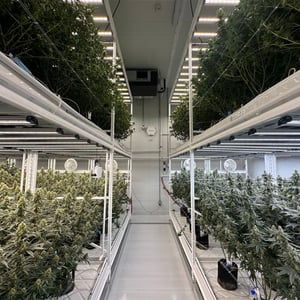
Many growers assume that LED diodes are the primary source of light fixture failures. In reality, drivers are typically the weakest component in the lighting system. Drivers are sensitive to heat, power quality issues, harmonic distortion, and electrical fluctuations–all conditions commonly found in commercial cannabis cultivation environments. When a driver fails, the entire light fixture can go dark, creating maintenance issues and potential crop risk.
In large facilities with hundreds or even thousands of light fixtures, these failures add up quickly. Every repair requires labor, troubleshooting, and access to the canopy, creating additional operational disruption. Traditional systems also generate more heat within the grow room and require additional electrical infrastructure, increasing both capital and operating costs.
The Role of Remote Power Servers
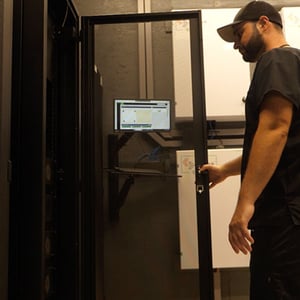
Remote power server systems remove drivers from individual light fixtures and centralize power management in dedicated server cabinets located outside the grow room. Rather than placing sensitive electrical components directly above the canopy, power is distributed from a centralized location where it can be monitored, maintained, and optimized more effectively.
This approach creates a driverless lighting architecture that simplifies facility infrastructure while improving reliability and control.
 Lower Installation Costs
One of the biggest advantages of remote power is reduced electrical infrastructure. Traditional lighting installations often require extensive wiring, contactors, and control hardware to manage dimming and scheduling. By centralizing these functions within the remote power server, cultivators can simplify installation and reduce labor costs. For large-scale facilities, these savings can significantly reduce upfront project costs while simplifying future expansion.
As Mark Doherty of Grow Rogue explains, the difference becomes apparent during construction:
"One of the biggest differences with TSRgrow's Remote Power system was how much electrical infrastructure we didn't need—wiring, contactors, panels, etc. That reduction in complexity meant less labor on the install and a lower overall cost of installation compared to traditional lighting systems we've worked with.
The build-out was noticeably more straightforward as a result. As we look ahead to future expansion, we can continue adding new rooms and fixtures without major electrical rework, which makes scaling the facility much easier to manage."
This experience highlights one of the primary advantages of TSRgrow's centralized power architecture. By reducing electrical complexity from the outset, cultivators can shorten installation timelines, lower labor costs, and build facilities that are easier to expand as production grows.
Reduced Energy and HVAC Costs
Every driver mounted above the canopy generates heat. In a facility with hundreds or thousands of light fixtures, that heat load becomes substantial and must be removed by HVAC equipment.
By relocating power components outside the grow room, remote power servers remove a significant amount of heat from the cultivation environment. TSRgrow estimates that remote power can remove up to 15% of heat from the grow area, reducing cooling requirements and lowering HVAC-related capital and operating costs.
The remote power servers also operate at greater than 95% efficiency while reducing harmonic distortion, helping facilities use power more efficiently and lower overall energy consumption.
Simplified Maintenance and Reduced Downtime
Maintenance can be one of the largest hidden costs in commercial cultivation. Drivers will always fail and, with traditional systems, servicing a failed driver often requires technicians to work above active crops, creating labor challenges, production disruptions, and contamination risks. Utilizing a system with remote power servers eliminates this issue by placing serviceable components outside of the cultivation environment. Modules can be hot-swapped and maintained from a centralized location without entering the grow room.
This approach delivers:
- Faster repairs
- Lower labor costs
- Reduced downtime
- Easier preventative maintenance
- Less disruption to active cultivation cycles
For facilities focused on cGMP readiness and operational consistency, maintenance outside the grow environment can also support cleaner operating procedures and reduced contamination risk.
Better Control Through Integrated Monitoring
Remote power servers do more than distribute power—they provide cultivators with greater visibility into the health and performance of their lighting system. When integrated with GROWHub cultivation software, operators can continuously monitor power usage, fixture performance, and lighting operations across the entire facility. Rather than discovering a problem after plants begin to show signs of stress, growers receive real-time alerts when a system deviates from expected performance.
This level of visibility makes troubleshooting significantly faster. Instead of manually inspecting light fixtures or tracing electrical issues room by room, cultivators can quickly pinpoint the source of a problem—whether it's a power module, a specific lighting zone, or another component within the system. Maintenance teams can diagnose issues remotely, identify exactly what needs attention, and resolve problems before they lead to extended downtime or crop impacts.
By combining centralized remote power with intelligent monitoring, TSRgrow helps cultivators move from reactive maintenance to proactive facility management, reducing downtime while ensuring lighting systems continue operating at peak performance.
Calculate Your Potential Savings
Every cultivation facility is different, which is why TSRgrow provides a Remote Power ROI Calculator to help cultivators evaluate the potential impact of centralized power architecture. The calculator estimates first-year financial benefits based on factors such as canopy size, energy rates, facility design, yield improvements, and operational savings.
Before comparing your next lighting fixture, consider the total cost of ownership. You may discover that the biggest savings opportunity isn't the light itself—it's the power system behind it.
Ready to explore how Remote Power could reduce costs, simplify maintenance, and improve reliability in your facility? Talk to a growing spcialist today.
